Q1. Distinguish between distance and displacement.
Solution
Distance
Displacement
1. It is the length of path traversed by the object in a certain time.
2. It is a scalar quantity that is it has only the magnitude.
3. It depends on the path followed by the object.
4. It is always positive.
5. It can be more than or equal to the magnitude of displacement
It is the distance traveled by the object in a specified direction in a certain time (that is the distance between the final and initial positions).
It is a vector quantity that is it has both the magnitude and direction.
It does not depend on the path followed by the object.
It can be positive, negative and even zero.
Its magnitude can be less than or equal to the distance
Q2. What do you understand by relative velocity?
Solution
Relative velocity is defined as the rate at which an object moves with respect to another moving object.
If A and B are two objects then, relative velocity of B with respect to A that is velocity of B as seen by A, vBA is given by-vBA = vB - vA and vAB = vA - vB
Q3. Explain instantaneous velocity and speed.
Solution
Speed of a body at any instant of time is called instantaneous speed . A moving body changes speed during its journey sometimes it speeds up, sometimes it speeds down and sometime moves with a constant speed. So the speed of the body at a particular instant of time is called instantaneous speed,
Instantaneous velocity in simple terms is the velocity of a body at a particular instant or at a particular point of its path.Mathematically it can also be said as the limiting value of average velocity of the body in a small time interval around that instant, when time interval approaches zero. When an object is in uniform motion , its instantaneous velocity is always the same as the average velocity
Q4. What does the slope of a line on velocity-time graph reveals about the acceleration of the object?
Solution
If the acceleration is zero, then the slope is zero (i.e., a horizontal line). If the acceleration is positive, then the slope is positive (i.e., an upward sloping line). If the acceleration is negative, then the slope is negative (i.e., a downward sloping line).
Q5. Distinguish between speed and velocity.
Solution
Speed
Velocity
1. The distance traveled by a moving object in one second is called its speed.
2. It is a scalar quantity.
3. Speed is always positive.
The distance traveled by a moving object in one second in a particular direction.
It is a vector quantity.
Velocity can be positive, negative or zero.
Q6. Under what condition will the distance and displacement of moving object will have the same magnitude?
Solution
The distance and displacement of moving object will have the same magnitude when the object moves along a straight line in the same fixed direction.
Q7. An object moves 10 m in the first 2 seconds, then 20 m more in the same direction in the next 8 seconds. Find the average velocity for the first 2 seconds, then for next 8 seconds and also for the total journey.
Solution
Average velocity = distance / time.For the first two seconds v avg = 10/2 = 5 m/sSimilarly, average velocity for the next 8 seconds = 20/8 = 2.5 m/s the average velocity for the entire duration = total distance/ total time = (10 + 20)/(2 + 8) = 3 m/s
Q8. A ball is thrown is vertically upward. What is its velocity and acceleration at the top?
Solution
At highest point velocity of the particle is zero and its acceleration is equal to the acceleration due to gravity acting in the downward direction.
Q9. A worker drops a hammer from the top of a 60m high building. If the speed of sound in air is 340 m/s, how long does the worker have to shout down to warn colleagues (if his warning is to reach them before the hammer!) Neglect air resistance.
Solution
For the hammer:
Initial speed u = 0
Acceleration a = 9.81 m/s2
Distance s = 60m
Using the second equation of motion, we get
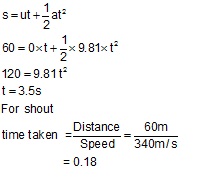 The length of time for the hammer to reach the ground minus the length of time it takes for the shouted warning to reach the workers on the ground gives the difference in travel time between hammer and shout.
That is, 3.5 - 0.18 = 3.32 s
Therefore the warning must be shouted within 3.32 seconds of dropping the hammer.
The length of time for the hammer to reach the ground minus the length of time it takes for the shouted warning to reach the workers on the ground gives the difference in travel time between hammer and shout.
That is, 3.5 - 0.18 = 3.32 s
Therefore the warning must be shouted within 3.32 seconds of dropping the hammer.
The length of time for the hammer to reach the ground minus the length of time it takes for the shouted warning to reach the workers on the ground gives the difference in travel time between hammer and shout.
That is, 3.5 - 0.18 = 3.32 s
Therefore the warning must be shouted within 3.32 seconds of dropping the hammer.
Q10. What is non-uniform motion? Give one example to explain non uniform motion.
Solution
When a body covers unequal distance in equal interval of time, its motion is said to be non-uniform.
Example: The velocity of a vehicle moving on a crowded road is different at different instant of time.
Comments
Post a Comment